
Why Strategy Dies Between the Boardroom and the Front Line
Written By: Winston Blackwood, PMP, PMI-PMOCP
The offsite went well.
Two days at a strategy retreat. A facilitator. Butcher paper on the walls. By the second afternoon, the executive team had converged on something genuinely good, a clear-eyed read of the market, three strategic priorities, commitments that people meant when they made them. The CEO closed with a line about this being the year it finally happens. There was applause, and it was not perfunctory.
Eighteen months later, nothing has changed.
Not “the strategy failed.” Nothing so dramatic. The strategy did not fail; it never arrived. Somewhere between the room where it was agreed and the people who would have had to do it, the signal degraded to nothing, and the most striking thing, the thing that should worry you most, is that nobody can say exactly when.
“Strategies rarely fail because they are wrong. They fail because nobody built the machinery to carry them.”
This is the most expensive recurring failure in corporate life, and it is almost universally misdiagnosed. Executives reach for explanations of character, people were not committed, middle management resisted, the culture is not ready. Occasionally true. Far more often, the strategy was never given a mechanism to travel through, and it did the only thing a signal can do without a conductor. It dissipated.
The execution gap is not a discipline problem. It is an architecture problem, and architecture problems are solvable, which is the good news buried in all of this.
Translation
The strategy was stated as an aspiration, not an objective. Most strategies die here, and they die at the top.
“Become the region’s most trusted energy partner.” “Deliver a world-class customer experience.” “Drive operational excellence across the enterprise.”
These are not objectives. They are moods. They are unfalsifiable — there is no state of the world in which you could look at them and say, definitively, that you failed. And an unfalsifiable goal cannot be executed, because execution requires knowing when you have arrived.
The translation test: could a competent person outside the executive team read this and know what they would have to do differently on Monday? If not, it has not been translated. It has been declared.
Which is uncomfortable, because it means the people diagnosing the failure are usually the people who caused it.
Cascade
Communication is not cascade. Telling people the strategy exists is not telling anyone which part of it is now their problem.
Suppose the translation is good and the objectives are sharp. Now: who owns them?
The standard answer is that they were “communicated.” There was a town hall. There was a deck. It went out on the intranet. And this is precisely the confusion at the heart of the failure. Cascade means telling a specific named person which part of the strategy is theirs, and agreeing with them how they will know if they are succeeding.
The two failure modes are cloning and fragmenting. Cloning is when every division gets the same corporate KPI, that is, “everyone owns customer satisfaction,” which means nobody does. Fragmenting is when every division invents its own measures with no line of sight upward, and the sum of the parts bears no relationship to the whole.
Here is the part that is easy to miss. The cascade does not fail because the executive team refuses to do it. It fails because everyone assumes it already happened.
I have sat in a series of interviews with divisional directors as part of a scorecard rollout, asking each of them what they understood the strategy to require of them. The executive team believed this ground had been covered comprehensively. It had been communicated at length, more than once.
What came back was not resistance. Every director was thoughtful, capable, and entirely willing. What came back was drift. Each had constructed a reasonable interpretation of what the strategy meant for their function, and each interpretation was different; not wildly, but enough. Enough that, laid side by side, they did not add up to the strategy. They added up to five adjacent strategies, each defensible, none of them the one that had been agreed.
Nobody had done anything wrong. The cascade had simply never happened, and everybody had assumed it had.
Measurement
A strategy measured by activity will produce activity. If a measure has never produced bad news, it is not measuring anything.
Tell a team you are tracking the number of customer touchpoints, and you will get touchpoints. Tell them you are tracking whether customers stayed, and you will get a different conversation entirely, a harder one, and the one you actually wanted.
The current shift in practice is decisive: away from dashboards of activity status, toward a small number of outcome measures senior leaders genuinely care about, financial outcome, risk reduction, delivery confidence, and strategic alignment. Fewer measures. Harder ones. Measures that could embarrass someone.
Reinforcement
A strategy is a decision that has to be re-made continuously. Without a protected cadence, it loses every fight it enters.
This is the least discussed and possibly the most fatal.
Without cadence, the strategy is not defeated. It is simply never the most urgent item on any given day. A quarterly aspiration will always lose to a Tuesday emergency, and there will always be a Tuesday emergency, until eighteen months have passed and the strategy is quietly no longer mentioned.
The cadence does not need to be elaborate. It needs to be immovable, senior, and about decisions rather than updates. Thirty minutes a month with the right five people, where the only question is “what did we change,” beats a two-hour quarterly review where forty slides are presented and nothing is decided.
Who owns the translation layer, and why most PMOs abdicate it
Owning it means telling an executive their strategy is not executable as written. Most PMOs decline.
Everything above describes machinery that must exist between strategic intent and daily work. Someone has to build it, and someone has to run it.
The PMO is the obvious owner. It sits across the whole portfolio, it has convening power, and it is already in the room where the work is discussed.
It usually is not, and the reason is worth naming plainly. Owning the translation layer means telling a director that their proposed measure is unfalsifiable. It means saying, in a room where nobody wants to hear it, that the cascade did not happen.
Most PMOs decline this. They report on the projects that exist rather than asking whether the projects that exist are the strategy. It is a safer job and a smaller one, and it is why the PMO is on the list in the budget round.
The uncomfortable part: your sponsor is probably the bottleneck
An approver signs the business case. A sponsor spends political capital. Most executives believe they are doing the second while doing the first.
There is a fifth cause, and it corrodes all four points at once. Weak sponsorship remains one of the most common causes of project failure, and PMOs have historically treated it as somebody else’s problem. It is not. It is the problem.
A sponsor clears roadblocks, spends political capital, makes the unpopular call, and is visibly, personally attached to the outcome. Nobody has ever told most executives the difference.
The encouraging development is that PMOs have begun taking this on, not by training executives to be project managers, but by acting as a critical friend: bringing evidence and structure to support better leadership decisions, rather than escalating and hoping.
You cannot escalate your way out of a weak sponsor. There is nowhere above them to go, and the attempt will end your programme and possibly your career. You have to develop one.
What a working translation layer looks like
Four artefacts and one habit. None of it is intellectually difficult. In most organisations, nobody is doing it.
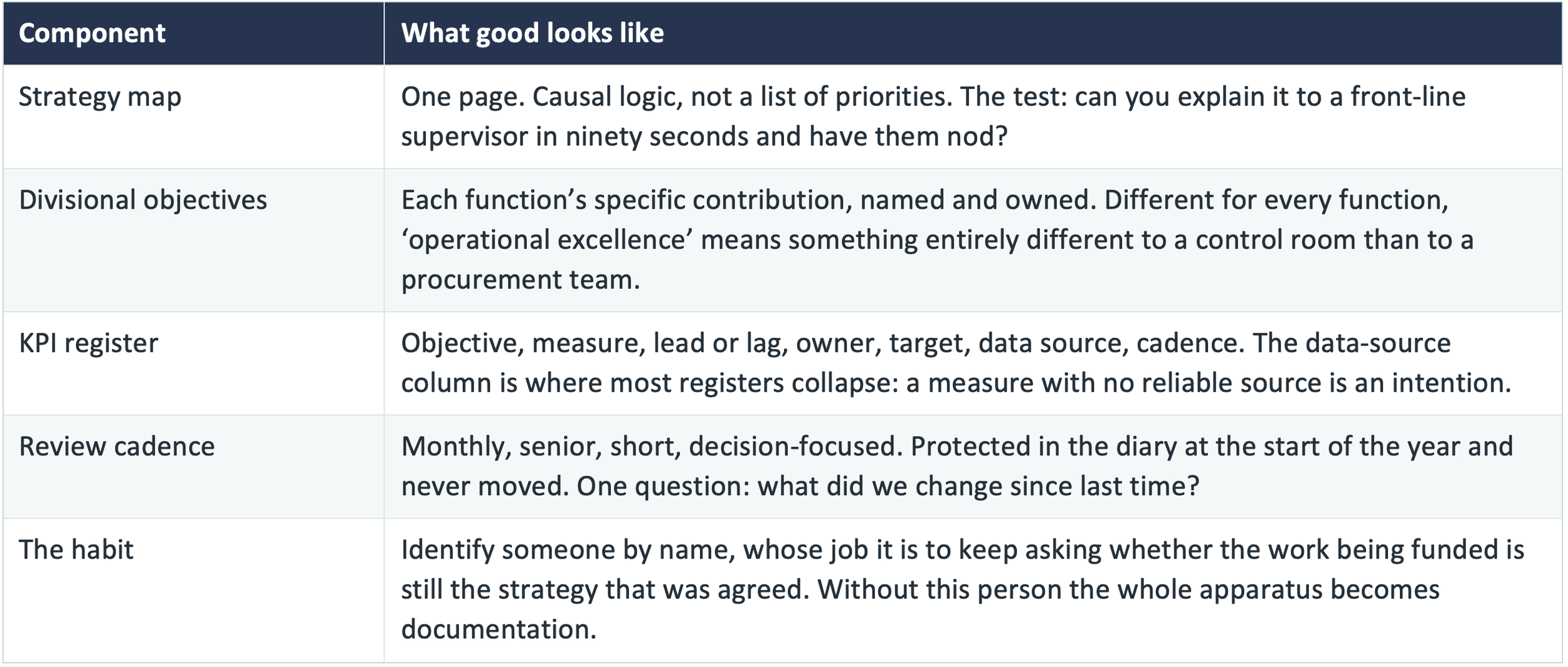
Transformation is an engineering problem, not a motivational one
You do not fix an architecture failure with a speech.
The instinct, when a strategy stalls, is to reach for energy. Another all-hands. A relaunch. A more compelling narrative.
This never works, because the problem was never a shortage of enthusiasm. Your people were enthusiastic at the town hall. They went back to their desks and discovered nothing about their week had changed; no new objective, no new measure, no new forum, no different answer when they asked their manager what to deprioritise. So they did what any reasonable person does. They carried on.
You fix that by building the machinery that should have been built the day the strategy was signed off: translate it, cascade it, measure it honestly, and protect a cadence that keeps re-making the decision.
Unglamorous work. Also, almost always, the difference between the strategy that lands and the one quietly replaced at next year’s offsite by a new one, which will also be excellent, and which will also die.
Is your Strategy signed off but stalled?
That is not a motivation problem; it is a missing translation layer, and it is fixable. X-AIL builds that layer: strategy map, cascade, KPI register, and a governance cadence that actually holds. Start with the free Strategy-to-Execution Diagnostic below; it walks you through the four points of signal loss and shows you where yours is degrading. Or send us your strategy deck, and we will tell you, in thirty minutes, which of the four is going to kill it.
→ Download the Strategy-to-Execution Diagnostic | → Explore PMO Design & Rollout