
No, Your PMO is Not the Compliance Police: What a PMO Actually Does in 2026
Written By: Winston Blackwood, PMP, PMI-PMOCP
The Unfortunate Reality of Today
Somewhere this quarter, in a budget review you were not invited to, someone is going to point at a line item labelled “PMO” and ask what it is for.
And the honest, uncomfortable answer is that nobody in the room will be able to say. Someone will offer that it is “governance.” Someone else will mutter that it produces the status reports. A third person will note, not unkindly, that projects seemed to get delivered before it existed. The line item will survive this year, because cutting it feels premature. It will not survive the next one.
This happens constantly, and it happens for a reason that has nothing to do with the quality of the PMO in question. It happens because the people making the decision are working from a definition of “PMO” that expired about fifteen years ago — and because the PMO itself has usually done a poor job of updating them.
So let us update them. The gap between what a PMO is assumed to be and what a good one actually does is now so wide that it is costing organisations real money — not in PMO salaries, but in the strategies that quietly die for want of anyone whose job it was to land them.
“The PMO is not the compliance police. It is the organization’s capacity to change, made deliberate”
Where the misconception came from
The caricature was once accurate. That is precisely why it is so hard to shift.
It is worth being fair to the past, because the caricature did not come from nowhere.
The first generation of PMOs solved a genuine problem. In the late 1990s, large organisations ran dozens of projects with no common language, no shared method, and no consistent way of knowing whether anything was on track. Every project manager improvised. Executives had no line of sight into anything.
The answer was standardisation: a common methodology, a template library, a stage-gate process, a consolidated report. And it worked. It was the right intervention for that problem, and a great deal of value was created.
The trouble is that it worked so well that it became the definition. “PMO” and “method enforcement” fused in the executive imagination and have not come apart since. Two decades later, the standardisation problem is largely solved — and the PMO is still being judged against the job it finished.
There are six myths. They are worth taking apart one at a time.
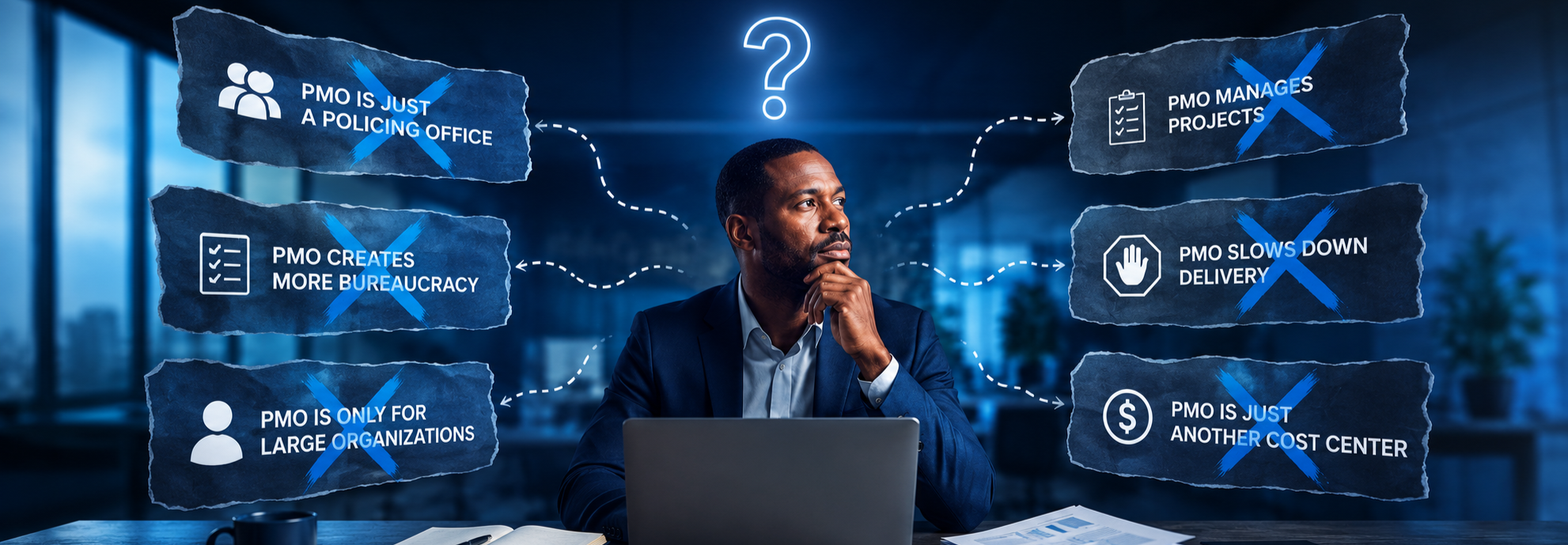
Myths about the PMO
Myth 1 - “A PMO is a governance function”
Governance is an instrument, not a purpose. Confusing the two is the load-bearing error.
A PMO uses governance the way a surgeon uses a scalpel, as one tool among several, applied where indicated, and put down when it is not. An organisation that defines its PMO as “the governance function” has confused the scalpel with the surgery.
What is the surgery? Two things, and they are the only two that ultimately justify the function’s existence:
• Delivery capability — the organisation’s ability to reliably convert intent into working reality. Not this project. The capability itself, which persists after the project is gone.
• Value realisation — ensuring that what was delivered actually produces the benefit that was promised, and noticing honestly when it does not.
A PMO that governs without building capability is a toll booth. A PMO that governs without tracking value is an expensive filing system.
The test: ask your PMO what the organisation is now able to do that it could not do two years ago. If the answer describes a process, it is a governance function. If it describes a capability, our sponsors know how to sponsor, our portfolio decisions take weeks rather than quarters, we can say what last year’s investment returned… then and only then, it is a PMO.
Myth 2 - “A PMO is overhead”
Often true — and conceding that honestly is what earns you the right to argue the rest.
Overhead is cost without attributable value. A great many PMOs are, by that definition, exactly overhead — not because the function is inherently valueless, but because they have never once demonstrated a value they could attribute. They report activity. They enforce templates. They chase updates. They cannot tell you what any of it was worth, because they have never tried to work it out.
If that describes your PMO, the sceptic in the budget meeting is not being unfair. They are being accurate, and the correct response is not to defend the function but to fix it.
Attributable value is more concrete than most PMO leaders imagine:
• Decision latency. If the PMO has taken portfolio decisions from a quarter to a fortnight, that is a number, and it has a cost of delay attached to it.
• Portfolio waste avoided. A PMO that kills two bad projects a year has usually paid for itself twice over before lunch.
• Benefit realised. Of the benefits promised in last year’s business cases, how many materialised? Almost nobody can answer this. The PMO that can is not overhead — it is the only part of the organisation telling the truth about its own investments.
• Failure cost avoided. Invisible, which is the tragedy of all preventive functions. Not unmeasurable — you have a history, and it has a run rate.
The PMO that arrives at the budget review with those four numbers is not defending a line item. It is presenting a return.
Myth 3 - “The PMO exists to report status”
Reporting is a by-product of knowing things. RAG status is close to a lying instrument.
This is the most damaging myth, because it is the one PMOs most often believe about themselves.
You know why RAG fails. Nobody goes red voluntarily. Going red invites scrutiny, and scrutiny arrives at precisely the moment you least have the capacity to absorb it. So projects go amber for months and then go red in the week they were due to deliver. The watermelon project — green outside, red all the way through — is not a failure of individual honesty. It is the rational response to an incentive structure that punishes early disclosure.
The field has moved decisively away from this. The direction of travel is toward a small number of outcome measures that senior leaders actually care about — financial outcome, risk reduction, delivery confidence, strategic alignment — and away from dashboards of activity status. Fewer measures. Harder ones. Measures that could embarrass someone.
The heuristic: for every tile on your executive dashboard, ask what decision it would change. If nothing, delete it. Most dashboards lose eighty percent of their surface area to this test and become dramatically more useful.
Myth 4 - “The PMO is where projects go to be slowed down”
Sometimes true. A good PMO removes more process than it adds.
A gate is either assurance or latency. An assurance gate exists because a decision must be made and someone with authority must make it. A latency gate exists because a form must be filled in and someone with a calendar must find a slot.
The test: what is the decision, who makes it, and what happens if the answer is no? If the gate has never once been failed — if “no” is not an available answer — it is not a gate. It is a queue with ceremony attached, and you should remove it this week.
The best evidence that a PMO understands its own purpose is a governance process that has got simpler over time rather than more elaborate.
Myth 5 - “Agile killed the PMO”
The opposite happened. Multi-modal delivery made the connector function load-bearing.
What agile killed was the single-methodology PMO — the one whose value proposition was “we all do it this way.” That role is gone, and good riddance.
What replaced it was not simplicity. It was multi-modal delivery: one team running Scrum, another running a two-year infrastructure build that cannot be iterative because you cannot pour half a foundation, a third on a vendor’s method. Three cadences, three definitions of done, one portfolio, one board that needs to understand all of it.
Somebody has to hold that view, and answer “what is the aggregate risk position across a portfolio delivered three different ways” without pretending the differences do not exist. That is harder than the job agile supposedly abolished, not easier.
Myth 6 - “The PMO sits apart from the business”
The distance was thought to preserve objectivity. It preserved ignorance, in both directions.
The classic PMO sat centrally, at a deliberate arm’s length, and issued things: templates, standards, reports, requests for updates.
The current shift is toward PMO capability embedded inside business areas — close enough to the work to understand it, close enough to the decision to influence it early, present in the room rather than represented in the report. The PMO becomes a connector: between strategy and delivery, between different delivery models, and between governance and pace.
Proximity builds trust, and trust is the entire currency of the function. A PMO nobody trusts can enforce a process. It cannot change an outcome.
What the current practice guidance actually says
Three findings from the PMO Practice Guide that will be unfamiliar to anyone still working from the compliance model.
None of the above is one consultant’s opinion, and it is worth grounding it — in a field this full of assertion, the person who cites the evidence wins the argument.
1. There is a perception gap, and closing it is the PMO’s job. PMO leaders and senior executives do not describe the same function. The PMO describes what it does; the executive describes what they see. Where those diverge, the executive’s version decides the budget.
2. The orientation is toward value, not process. Operational excellence is table stakes. Doing the projects well is the price of admission, not the contribution. The contribution is strategic: which projects, in what order, delivering what value, and how do we know.
3. Customer-centricity is a PMO capability. The PMO has customers — delivery teams, sponsors, the executive committee — and serving them is a discipline in its own right. A PMO that has never asked its delivery teams what would actually help them is not doing the job, however immaculate its templates.
So what does a modern PMO actually own?
Five things. Notice what is absent from the list.
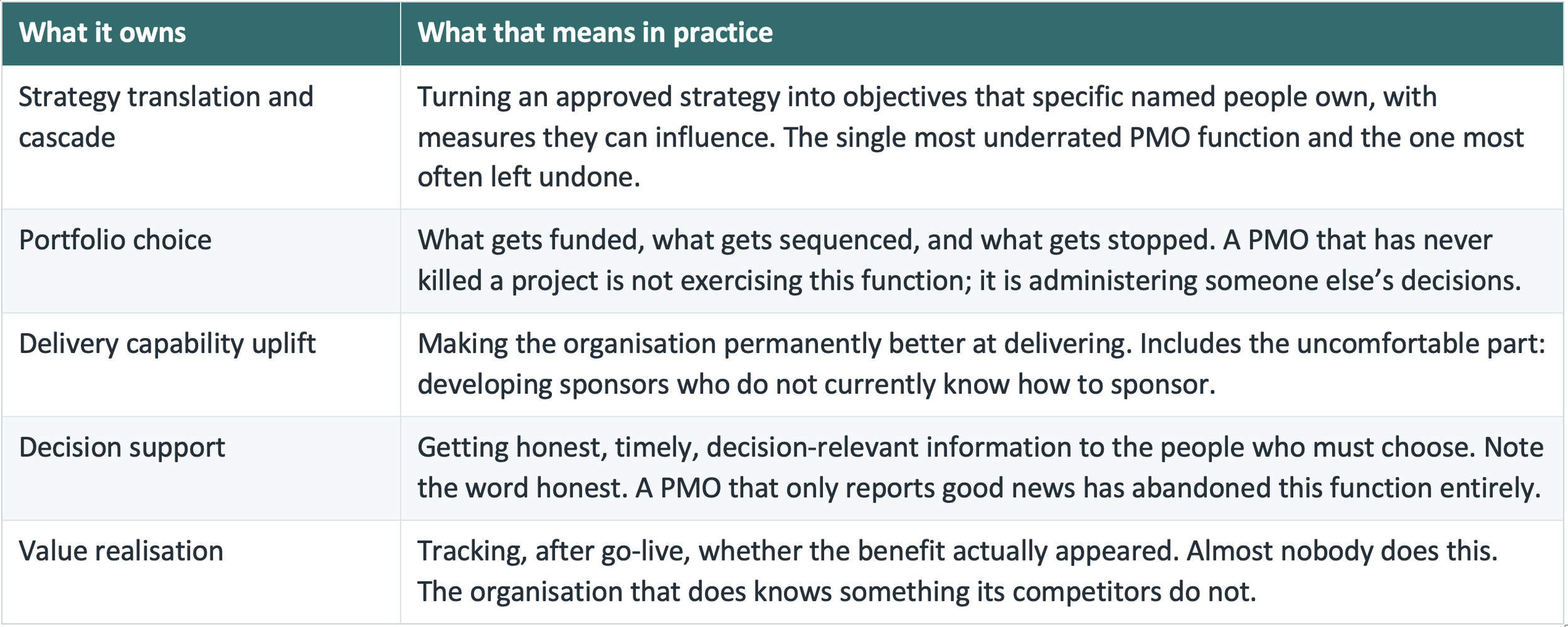
The PMO owns a Value Driven Customer Centric Operations and adds proven tangible value
Templates are NOT on that list. Method enforcement is NOT on it. Status collation is NOT on it. Those are things a PMO may do, in service of the five. They are not what it is for, and increasingly, they are the parts a well-configured toolset and a competent AI assistant can absorb, which is exactly why a PMO whose identity rests on them is in genuine trouble.
The view from both sides of the table
The perception gap is not fixed by explaining. It is fixed by producing a decision and making sure the right person watched.
I have had the unusual experience of sitting on both sides of this conversation, as the person a PMO reports into, and as the person defending a PMO’s existence.
The moment that reframed it for me was hearing a senior colleague, entirely without malice, describe the PMO as “the administrative side of the projects.” He was not being dismissive. He was describing, accurately, what he had observed. And that was the point: he had never seen the PMO make a decision. He had only ever seen it produce a document. From where he sat, the description was fair.
The corollary is the proof. Arguments do not move executives; worked examples do.
The most useful thing I have seen a PMO function do was not a report. It was a prioritisation model, built for consumption at the SVP level, deliberately simple, deliberately hard to argue with, that took a backlog of competing remediation work and produced a defensible order. It did not describe the problem. It resolved an argument that had been running for a year, and it changed where the money went that quarter.
That is what a PMO is for. One instance of it is worth a hundred pages of status.
Six questions to ask about your own PMO
Answer as your executive committee would answer, not as you would.
Can the PMO name a decision, a real one, with money attached, that it caused to be made differently in the last six months?
Has it stopped a project in the last year? If not: were there no bad projects, or is stopping not something it is empowered to propose?
Can it tell you what benefit last year’s completed projects actually delivered, not what was promised, what appeared?
Do delivery teams come to it for help, or only to comply with it? Ask them. The answer will be instructive.
Does the executive committee use its reporting to make decisions, or to be reassured? These are different activities and produce different reports.
Has the governance process got simpler in the last two years, or more elaborate?
Four or more “no” answers and the critics in your budget meeting are right. Not a comfortable finding, but a fixable one, and considerably better than being surprised by it.
The reframe
A PMO is the organisation’s capacity to change, made deliberate.
The PMO is not the compliance police. It never really was - that was always an artefact of the era in which the function was invented, and the era has ended.
What a PMO is, when it works, is the machinery that converts a strategy from a document into a set of things people actually do. It is the mechanism by which an organisation decides what not to do, which is the harder half of strategy. And it is the only function whose job it is to come back eighteen months later and say, plainly, whether the thing you paid for actually worked.
Organisations that understand this fund it properly, and their strategies land.
Organisations that do not, cut it in the budget round — and then spend three years wondering why nothing they decide ever seems to happen.
Is your PMO being judged against a definition that expired a decade ago?
If so, the answer is not to defend it, it is to redefine it, with evidence. Our PMO Health Check is an independent assessment of what your PMO is currently worth to your organisation, and a costed plan to make it worth more. It takes about three weeks, and it tends to be uncomfortable in a useful way. Reach out and start with a free PMO Maturity & Value Self-Assessment below, thirty questions, five dimensions, and a one-page profile of where you actually stand.
→ Take the PMO Maturity & Value Self-Assessment | → Explore the PMO Health Check