
PMO vs. EPMO vs. VMO vs. PMO-as-a-Service: Which One Do You Actually Need?
Written by: Winston Blackwood, PMP, PMI-PMOCP
Short answer: a PMO governs and supports project delivery within a function or division. An EPMO does the same at the enterprise level and owns portfolio choice, which initiatives get funded at all. A VMO shifts the emphasis from delivering projects to realising value, and is measured on benefit rather than delivery. PMO-as-a-Service rents the capability from outside rather than building it in-house. Most working organisations end up with a hybrid, and that is not a failure of purity; it is usually correct.
The longer answer is that choosing between them is not really a question about org design. It is a question about what is actually broken — and if you diagnose that wrongly, you will build a beautifully structured function that solves a problem you did not have.
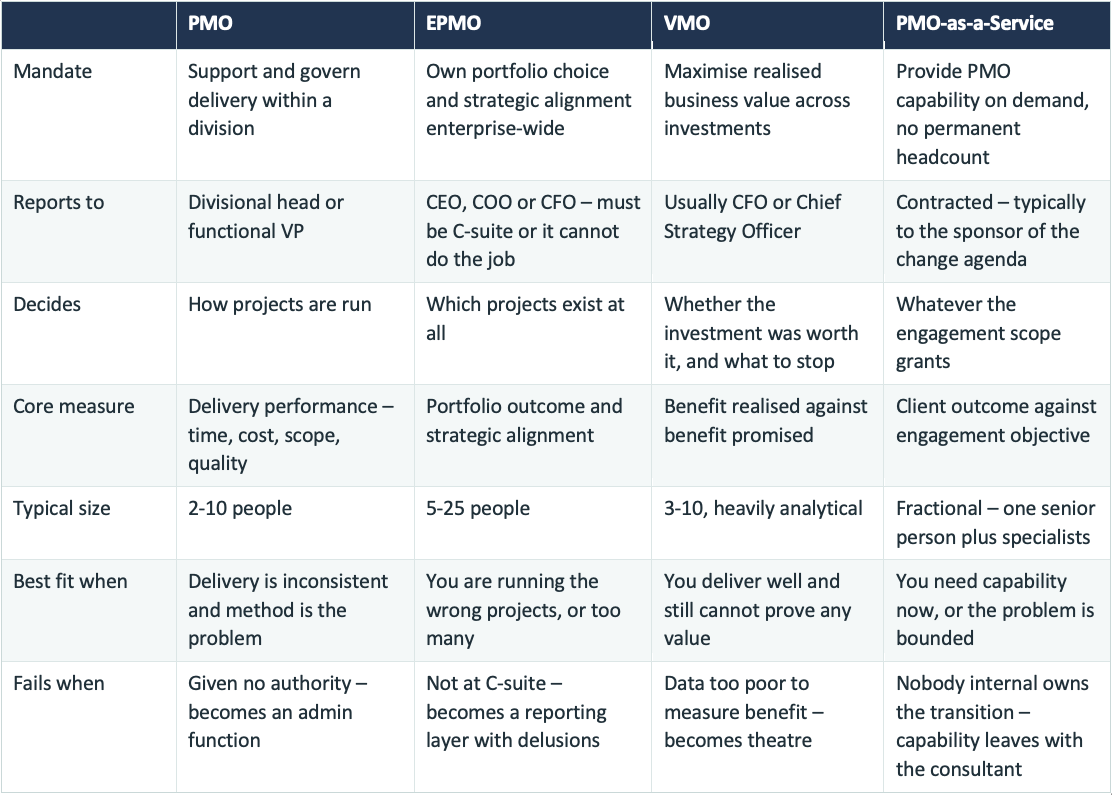
The Comparison at a Glance
Read the ‘fails when’ row first. It is the most useful row in the table.
PMO - The Delivery-Capability Function
Right far more often than the fashionable literature suggests. Fatal without authority.
A PMO exists where delivery is the problem: projects are late, quality is inconsistent, project managers are improvising, nobody has a reliable view of what is happening.
Good at: raising the floor. It takes an organisation where outcomes depend on which project manager you happened to get, and makes performance predictable regardless.
Fails when: given responsibility without authority. A PMO that can advise but not decide, that can report but not stop, degrades within two years into an administrative function everyone routes around. If the sponsoring executive will not grant it the power to say no to anything, do not build it. You will spend money creating a function whose subsequent redundancy will be used as evidence that PMOs do not work.
EPMO - The Portfolio-Choice Function
Not a bigger PMO. It answers a different question, and it cannot answer it below C-suite.
A PMO asks: are we running these projects well? An EPMO asks: should these projects exist? Different questions, different people — and an organisation that needs the second and builds the first has bought an expensive irrelevance.
The defining constraint: an EPMO that does not report into the C-suite is not an EPMO. Portfolio choice means telling a divisional director their pet initiative is being cancelled. That requires enterprise authority. Without it, the EPMO produces a beautiful prioritisation matrix that everyone will admire and nobody will obey.
Consider one when: you have more approved initiatives than capacity to deliver them, and no honest mechanism for choosing. Extremely common and rarely acknowledged — because acknowledging it means admitting several sponsored projects will never get the resources they were promised.
VMO - The Value-Realisation Function
The genuine version needs data. Without it you have built a rebrand.
The real version addresses a genuine and embarrassing gap: most organisations cannot tell you what last year’s completed projects actually returned. The business cases were approved, benefits were forecast, projects delivered — and nobody ever went back to check.
The prerequisite: a VMO needs data. If your organisation cannot currently attribute a financial outcome to an operational change, a VMO will not fix that — it will produce sophisticated-looking value reports built on numbers nobody believes. Fix the measurement capability first.
The honest reading: for many organisations, ‘VMO’ is what a good EPMO does anyway. If renaming it is the only way to get the executive team to care about benefit realisation, rename it — but know you have made a political move, not an organisational one.
PMO-as-a-Service - Renting the Capability
The test is what remains six months after the invoice is paid.
Fits when: the problem is bounded (stand up a PMO, recover a troubled programme, run a governance review); the organisation is too small to justify a permanent senior PMO director; or you need someone with scar tissue and you need them this quarter, not in nine months.
Fails when: nobody internal owns the transition. If the capability leaves with the consultant, you did not buy a PMO — you rented a set of documents. Any consultant unwilling to be measured on what remains after they leave should not be engaged.
The Decision Tree
Five questions, in order. Stop at the first clear yes.
Are we delivering the wrong things? Too many approved initiatives, shifting priorities, nobody can name the top three → you need portfolio choice. EPMO, at C-suite level.
Can we prove any of it was worth doing? Projects deliver, nobody can attribute value → you need value realisation. VMO function — but it needs data before it needs a name.
Are we delivering the right things badly? Priorities clear, execution inconsistent → classic PMO, with real decision authority.
Do we need this now, or need it permanent? Now → rent it. Permanent → build it, but consider renting while you build, because standing up a PMO badly is worse than not having one.
Are we honestly big enough for any of this? Which brings us to the question nobody in the literature asks.
What This Looks Like at a Realistic Size
Structure is not the variable that matters. Authority is.
Nearly all PMO literature is written for organisations with thousands of employees and dozens of concurrent programmes. That is not most organisations, and it is emphatically not most organisations in our region.
If you have three hundred people and six concurrent initiatives, the correct answer is almost never a fifteen-person EPMO. It is one genuinely senior person with real authority, a portfolio view that fits on a page, a monthly decision forum that actually decides things, and the discipline to stop initiatives rather than starving them.
That is a minimum viable PMO, and it will outperform a large one that has been given no power.
Choosing a model too heavy for your organisation is one of the most common and most expensive PMO mistakes — and it is almost always made by copying a design from a company forty times your size.
Frequently Asked
Mark these up with FAQ schema — they target the People Also Ask box.
Can a PMO and an EPMO coexist? Yes, and in large organisations they should. Divisional PMOs handle delivery; the EPMO handles portfolio choice across them. The relationship must be explicit or you get two functions arguing about who owns the report.
Is a VMO just a rebranded PMO? Sometimes, honestly, yes. The real version has data, authority to stop investments, and is measured on realised benefit. If it has none of those, it is a rebrand.
How many people should a PMO have? Fewer than you think, with more authority than you were planning to give them. A two-person PMO that can stop a project beats a ten-person PMO that can only report on one.
What is the most common mistake? Choosing the structure before diagnosing the problem — then giving the resulting function responsibility without authority.
Still Not Sure Which Model Fits?
That is the first question our PMO Health Check answers — not by asking what structure you want, but by diagnosing what is actually broken. Sometimes the answer is that you do not need a new function at all; you need to give the one you have some authority. Use the free PMO Model Selector below — six questions, and it will tell you which model fits and why.
→ Use the PMO Model Selector | → Explore the PMO Health Check